How much does it cost to build a house in Guatemala per square meter
Maybe you have not bought the land yet, or you already have the lot and the money does not stretch to what you imagined. Perhaps you live in the United States and are thinking of sending funds for a house in Guatemala. In either case, you ask the same thing: how much does a square meter cost? There are published figures for 2026, and below you will see them with their date and source. But a price per square meter only helps when you know what it covers: rough construction, a finished house or something in between, and at what finish level. In addition, the land, design, permits and utility connections usually fall outside it. Here you will find how to separate each part of the money and what to ask each builder in writing.
Key takeaways
Published figures per square meter change a lot by finish level
A single figure means nothing if you do not know which house it belongs to. That is why price guides divide construction into levels. According to estimates published by Living in Guatemala, with materials data as of October 7, 2026, and by House Guatemala, in a note dated June 6, 2026, the ranges per square meter are as follows.
Both are commercial guides and present the ranges as editorial estimates for Guatemala, not as an official rate or a national average. In the standard range they agree on Q3,500 to Q5,500, which is a reasonable reference for starting a conversation, never for signing a contract.
Living in Guatemala describes the basic level with block walls, a sheet-metal (lámina) roof, a cement floor and basic electrical installation, and the standard level with plastered and painted walls, a concrete slab, ceramic floor and a bathroom with tile. House Guatemala states that its ranges include materials and labor for rough construction plus finishes, and exclude land, design, permits and site development.
To see how much a calculation can vary by project, a 2023 thesis from the Universidad del Istmo shows, for one specific academic project, a price of Q5,062.92 per square meter, which includes engineering, design, permit, permit processing and contingencies. It is a particular case, not a general rate.
Rough construction, finishes and a finished house do not mean the same thing to everyone
In Guatemala, "obra gris" (rough construction) usually names the structure and main elements before the visible finishes. Depending on the company, it can include foundation, structure, walls, embedded installations, slab or roof, and some plastering. "Finishes" usually means floors, paint, doors, windows, cabinets, plumbing fixtures and wall coverings. One proposal may put finished installations inside the finishes, and another may leave them out.
There is no single definition that forces all companies to include the same items, so the safe way to compare is to ask for the list. For two prices per square meter to sit side by side, ask that each proposal state:
- Area: the exact square meters used for the calculation, and how they were measured.
- Scope: whether the price is for rough construction, finishes, or a finished house.
- Structure: foundation, walls, roof or slab, and stairs.
- Installations: electrical, plumbing and special systems.
- Finishes: floors, paint, doors, windows, kitchen and bathrooms, with brand or quality.
- Professional services: design, plans, structural calculation, supervision and management, included or separate.
- Permits and fees: building permit, other permits, utility connections, taxes and fees.
- Logistics: transport, freight, equipment, cleaning and waste removal.
- Terms: payment method, validity of the offer, timeline, changes and written warranty.
The money to build covers much more than the construction price
Someone who asks "how much money do I need" usually thinks only of materials and labor. The total budget brings together more items, and you should ask each proposal to separate them: land, design and plans, professional fees, building permit and permits, foundation and structure, walls and roof, installations, finishes, water, drainage and electricity connections, supervision and administration, and contingencies.
There are some reference figures in that list. House Guatemala suggests setting aside 3% to 8% of the construction cost for design and plans, and 10% to 15% for contingencies. These are commercial suggestions, not obligations or official rates. For the building permit and permits, the cost depends on the municipality. And connection and supervision costs have no national rate; they should appear in every budget.
One useful note for anyone comparing: budgets for academic projects, such as those in theses from Guatemalan universities, show how a building is broken down into line items. But they belong to specific projects and cannot be used to calculate the cost of another house.
The factors that move the price can be asked about one by one
If two builders give you different prices, the gap almost always lies in something you can ask about. The published guides mention these factors:
- Finish level: from basic to luxury, with different ranges per square meter.
- Roof type: sheet-metal roof at the basic level, concrete slab at the standard level.
- Land and slope: a lot with uneven ground or soil problems can require deeper foundations.
- Municipality: permits and some costs vary between municipalities.
- Who buys the materials: the quote may include them or leave them to the owner, and it should say who pays transport, waste and storage.
- Site access: distance and difficulty getting materials in can appear as separate charges.
- Number of levels and complexity: stairs, bathrooms, kitchen, large openings and exterior works change the scope.
- Price of supplies: they change every month, so a short validity period on the offer makes sense.
The National Statistics Institute (INE) publishes the Construction Materials Price Index, which measures the monthly change in 89 materials and services, with December 2018 equal to 100. It helps show how supplies move; it does not by itself give the cost of a house or the price per square meter. For tracking buildings, the INE also publishes a Construction Cost Index, which covers single-family homes in its first phase.
The building permit is handled by the municipality where the land is located
Each municipality sets its own requirements, fees and documents, so the first step is to check the one where the land is. Two examples, given only to illustrate how the procedure is organized.
In Guatemala City, the One-Stop Window (Ventanilla Única) says the applicant obtains the forms and requirements for the type of request, fills them in, attaches what is required, submits the file, and waits for notification or checks progress. On its documents page, Agreement COM-012-04 appears, which sets the costs per square meter of construction and the fees for a building permit, published 14 June 2004, together with later agreements. They must be reviewed against the type of work and the current version of the procedure.
In Mixco, the Construction and Urban Planning Regulations establish that to build, excavate, level, extend, modify, repair or demolish, a municipal permit must be obtained first. For certain types of work it requires a form signed by the owner and an active licensed professional (profesional colegiado), a certificate from the General Property Registry (Registro General de la Propiedad) and an identity document. Its query and payment portal has the building permit option.
If your land is in another municipality, do not use those rules as your own. Gather the owner's identification and the property documents, and ask the permits office which plans, forms and fees apply.
Builders publish few rates and ask for plans before quoting
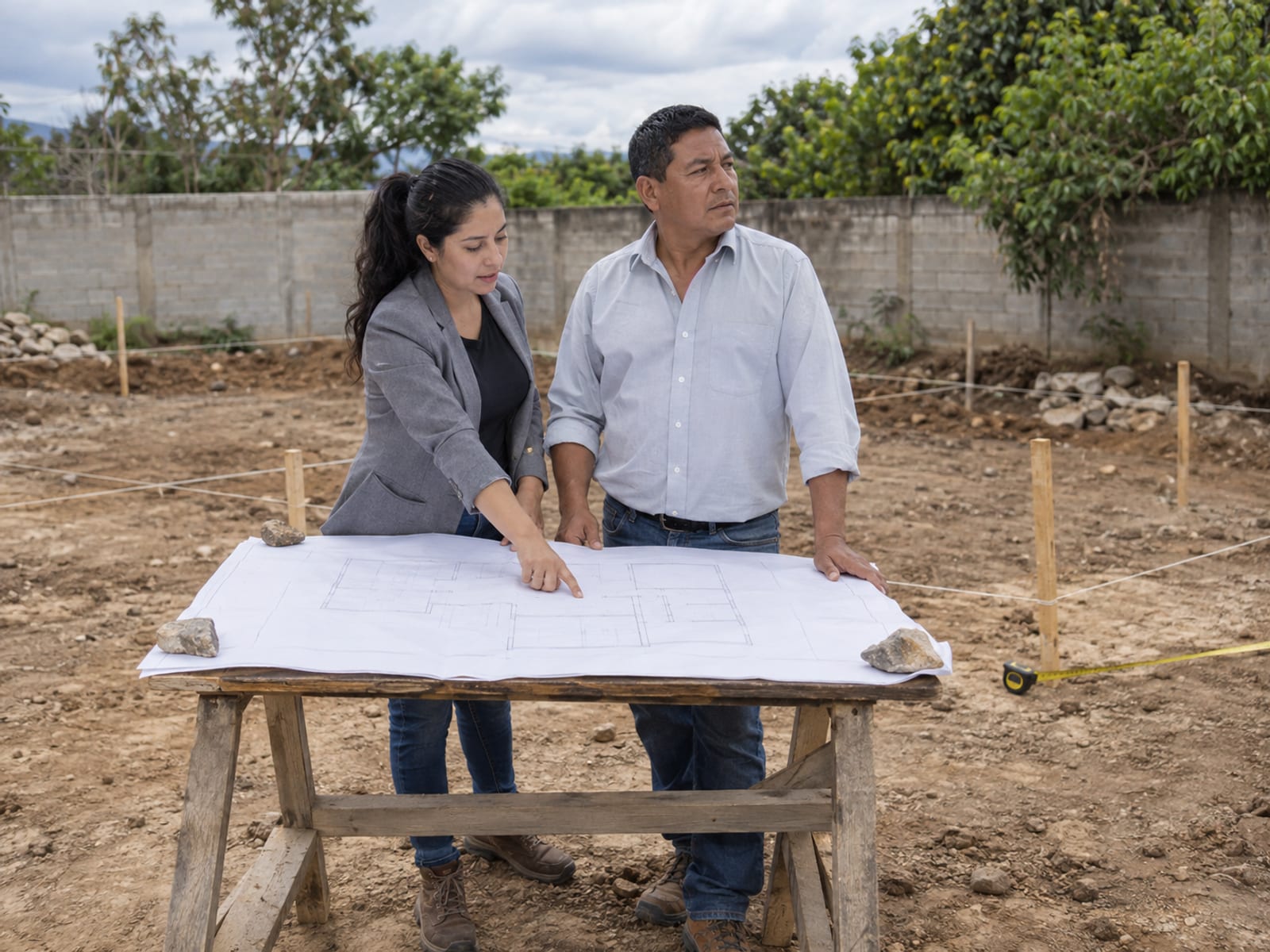
Many companies do not publish a general price per square meter, and that is normal. EMOSA, for example, builds one- and two-story homes and explains that the cost depends on size, number of levels, soil type, foundation, installations and finishes, and that it prepares a detailed proposal from plans or from a clear description of the project. It is a good example of how a quote is started: with information, not with a figure heard secondhand.
That is why, with each builder, you should ask the same questions in writing:
- Is the price for rough construction, finishes or a finished house?
- What is the exact area and how is it measured?
- Does it include materials, labor, transport and equipment?
- Which foundation, structure, roof, installations and finishes are included?
- Does it include design, plans, calculation, supervision and management?
- Does it include the permit, other permits, connections, taxes and fees?
- Which items are excluded, and which brands or qualities will be used?
- How long is the quote valid, and how are changes approved?
- What is the payment method and how does it relate to progress?
- What written warranty is offered, and for how long?
The Consumer and User Protection Law (Ley de Protección al Consumidor y Usuario) requires that service providers honor the conditions under which the service was offered or agreed, and that whoever guarantees a service state the warranty period in writing. The law does not include a construction quote template, so what you put in writing is what will serve you later.
Frequently asked questions about building a house in Guatemala
How much does it cost to build a house in Guatemala per square meter?
The 2026 estimates range from Q2,500 to Q3,500 per m² at a basic level up to Q8,000 to Q15,000 at the luxury level according to Living in Guatemala, and from Q2,800 to Q12,000 or more according to House Guatemala. They are not official rates.
Does the price per square meter include the land?
Not necessarily. House Guatemala states that its ranges exclude land, design, permits and site development. Ask that the quote say whether it includes or excludes the lot, connections, site development and exterior works.
What is the difference between rough construction and finishes?
Rough construction is usually structure, walls, roof or slab and basic works. Finishes are usually floors, paint, doors, windows, cabinets and final touches. The scope varies between suppliers; ask for the list of items.
Is there an official 2026 construction price table?
The INE publishes materials and construction cost indexes, and the Guatemalan Chamber of the Construction Industry (Cámara Guatemalteca de la Industria de la Construcción) publishes materials price lists. These are tables of supplies or price change, not a total price per square meter for a house. For your project, ask for a detailed and current budget.
How much does a builder charge to build a house?
It depends on size, levels, soil, foundation, installations and finishes. A quote should state the scope, materials, permits, design, exclusions, timeline, payments and warranty.
What should a construction quote say?
The area used, whether it covers rough construction or a finished house, materials, labor, installations, finishes, permits, taxes, transport, exclusions, timeline, payment method, validity, changes and warranty.
What to do before accepting a proposal
Before you compare numbers, set the municipality where the land is, the approximate area, the number of levels and the scope you want: rough construction, finishes or a finished house. Ask two or three builders for a written proposal with the same list of items, and ask separately about land, design, permits, connections, taxes and transport. Consult an architect or engineer for the design, calculation and budget of your project, and a lawyer if the land or the contract raises doubts.
With those answers, the figures of Q2,500 to Q15,000 per square meter stop being a number that scares or excites you, and become a frame for judging what is actually proposed to you. Keep the quotes, contracts, invoices and messages, because they are the documents that support any claim before DIACO, Guatemala's consumer protection office.
At Albañiles Guate we help people in Guatemala find and contact masons, builders and related construction trades by service and by location. You can look at the builders directory to find who to ask for proposals, or write to us from the contact page if you want help organizing your build.
Related guides
Masons in Villa Nueva: how to request and compare quotes
Masons in Villa Nueva: compare day rate, price per square meter and complete job, then request a written quote covering materials, helpers and payments.
Earthquake-resistant construction: what to ask your builder
What to ask your builder for an earthquake-resistant house in Guatemala: plans, signed structural design, applicable standards, supervision and membership.
MARN environmental license for building: when it applies
MARN environmental license for a house, apartments or subdivision: which project details to prepare, when a registered consultant is needed, and when to wait.