
How much does it cost to demolish a house in Guatemala
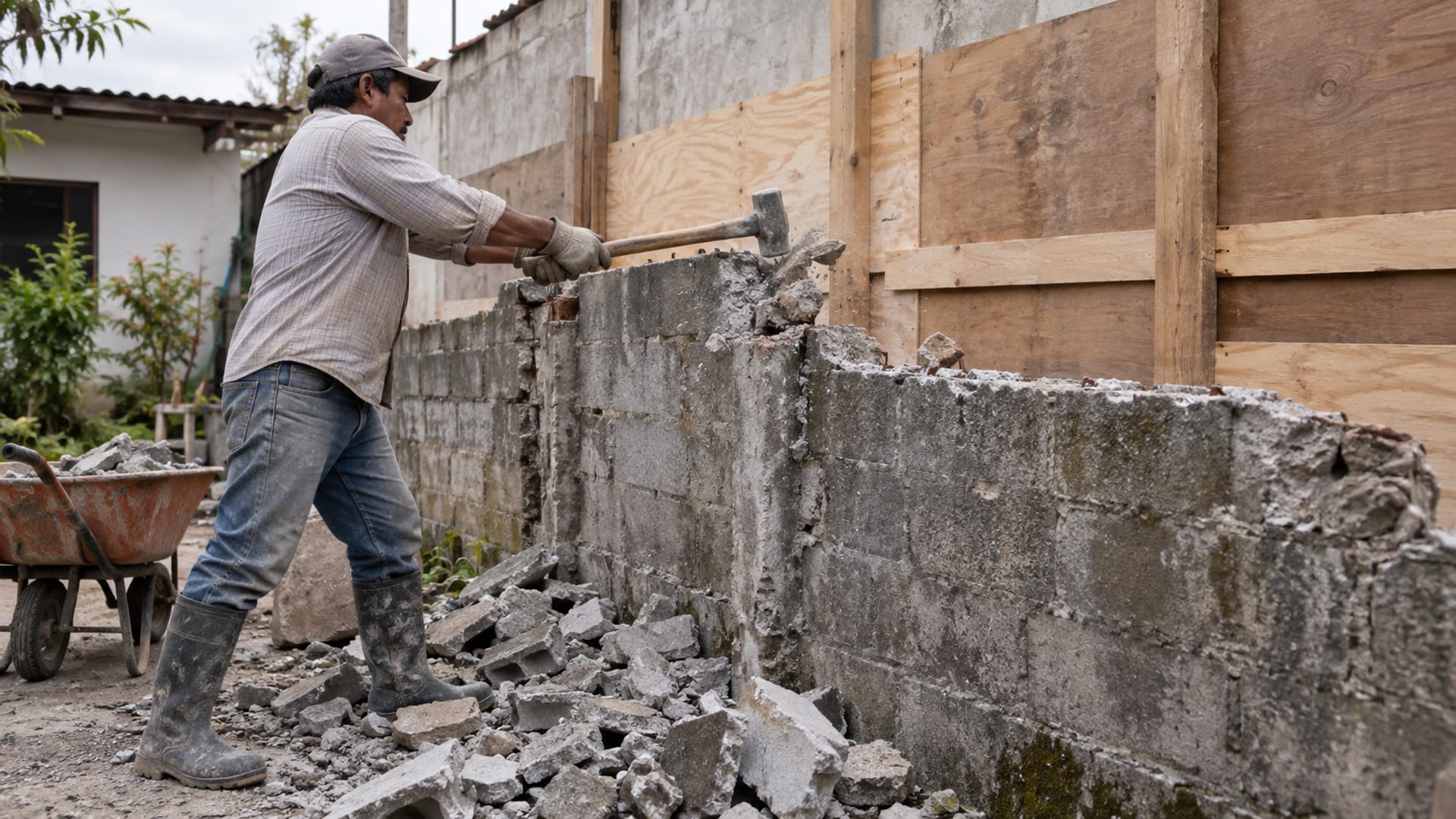
You inherited an old house, want to build a new one on the same lot, or need to sell a clear lot, and the first question is how much it costs to demolish a house in Guatemala. The answer does not fit in one number. One quote may talk about square meters, another about cubic meters, and a third about one lump-sum price. Each can include different things: the teardown, the loading, the transport, the place where the rubble is delivered, the cleanup, and the protection of the neighboring houses. If you also live abroad and must coordinate everything from a distance, comparing offers that do not cover the same work becomes even harder. Before you ask for prices, it helps to know what to ask, which documents to gather, and what each authority says about the permit and the rubble. With that in hand, you can ask for quotes that you can actually compare.
Key takeaways
What does a demolition usually include, and what can it leave out?
When someone says "tear down the house," they may mean very different things. For some people it means knocking down the walls and the roof; for others it means leaving the lot ready to build on, with no foundation or floors left. That is why the first step is to separate the tasks that make up the scope, and to ask each quote to say which ones it covers.
- Teardown: it can be done by hand, with machinery, or with a combination of both, depending on what the contractor proposes.
- Loading and transport of the rubble: removing the material from the property and carrying it by truck; it may be charged per trip or included in the total.
- Delivery to an authorized site: this is the final disposal, which is not the same as removing the material from the property.
- Cleanup: the quote should say what condition the lot will be left in when the work ends.
- Foundation and floors: some proposals remove them and others leave them; ask for this in writing.
- Permits and paperwork: clarify who handles them and who pays the fees.
- Protection of adjoining property: this refers to the neighbors' walls, sidewalks and gates.
A price gap between two offers is often a gap in scope, not in rates. If one quote covers only the teardown and the other adds transport, delivery of the rubble and cleanup, the two cannot be compared directly.
How much is published per square meter or per cubic meter?
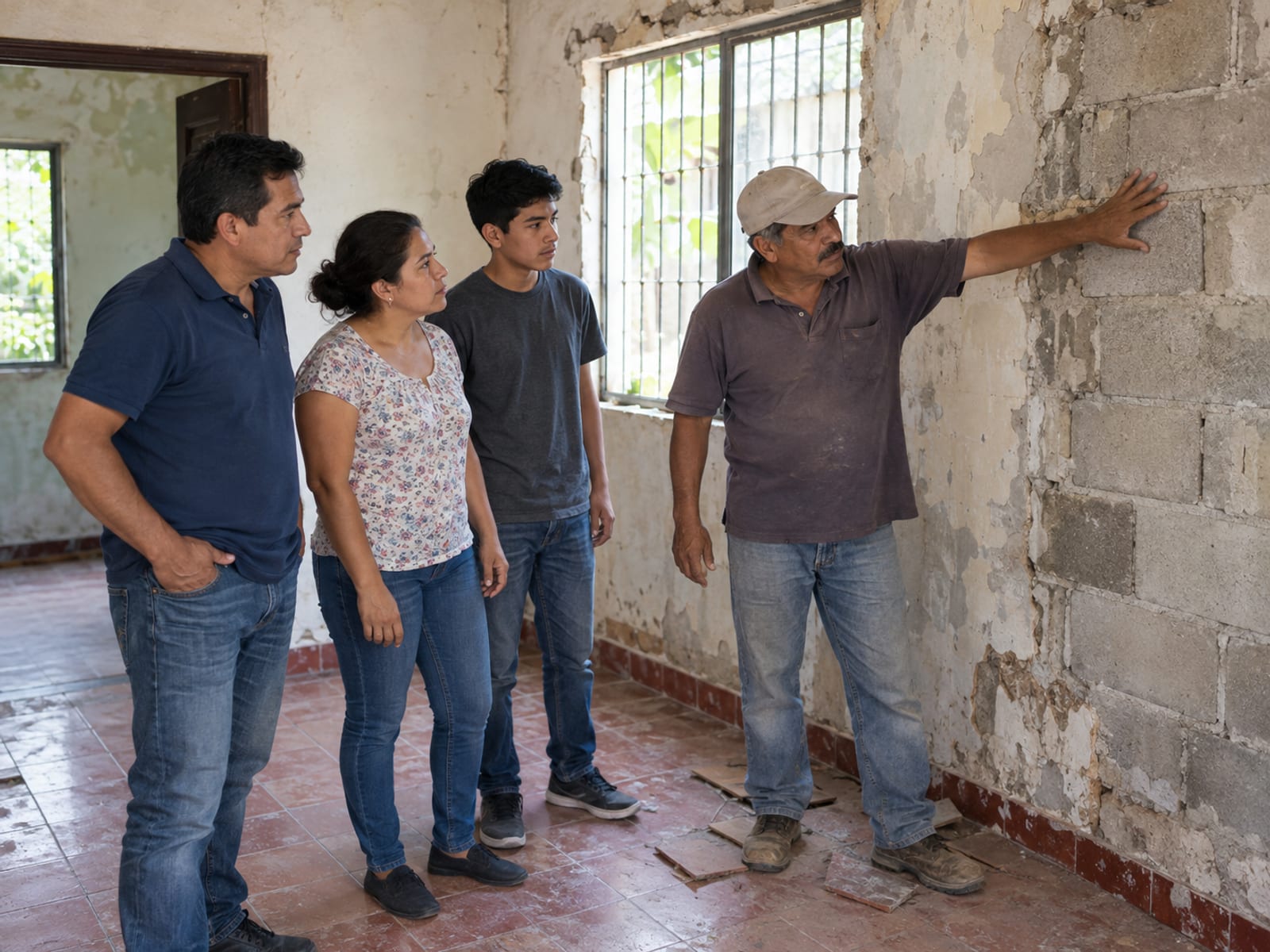
The published figures are not a national rate and not an official average for demolishing a whole house. They are references with different units and scopes, and they work as a starting point for asking questions, not as final prices.
The price generator of CYPE Ingenieros for Guatemala publishes in 2026 its activity DCP010, partial demolition of a building, measured per cubic meter. For an isolated building up to 4 meters high, between 500 and 1,000 m², with a concrete structure in normal condition, it publishes Q104.12 per m³. For a building between 8 and 12 meters high and between 200 and 500 m², the same generator publishes Q137.43 per m³. And for a building between 8 and 12 meters and between 500 and 1,000 m², with adjoining constructions, another of its pages publishes Q130.23 per m³.
Those three prices include demolition by hand and by machine, removal and stockpiling of the rubble, cleanup, and mechanical loading onto a truck or container. They exclude demolition of the foundation and the ground beam (solera), and the final disposal fee. It is a price generator, not a quote for a particular house, and these figures apply to buildings of considerable size.
For a reference per square meter, the INTECAP contract GE-AL-3-2024, dated March 2024, sets Q43.60 per m² for the demolition of 102.47 m² of false ceiling. It includes dismantling the access panels and the framing, and moving the rubble in sacks to an authorized dump. It is a specific interior item and not the price of demolishing a house.
Notice that prices per cubic meter cannot be turned into square meters, and cannot be mixed with the INTECAP price or with a price per trip. So, when a contractor says "so much per meter," ask whether they mean square meters of construction or cubic meters of material, and what that price includes. For a specific house, the number comes from a written quote that starts from its address, its area and its access.
What raises or lowers a quote?
The same price generators show which factors move the calculation: the height of the building, its surface area and volume, whether it stands alone or is attached to other constructions, the type of structure and its condition, the use of manual or mechanical means, the loading of rubble onto a truck or container, and removal or cleanup. Each one weighs differently on each job, so do not assume a fixed surcharge for having a concrete slab instead of a sheet metal roof, a sloped lot or a narrow access road. Each of those points is a question for the contractor, and the answer should be written into the quote.
Three factors deserve special attention if you coordinate from far away. The first is access: if a large truck cannot enter the street, the rubble is loaded onto smaller vehicles and the trips multiply. The second is neighboring construction: a house that shares a wall with another needs more care. The third is the foundation: we already saw that some references exclude it, and removing it may be part of leaving the lot ready to build on.
Do I need a permit to demolish a house?
It depends on the municipality where the property is located, because each municipality sets its own procedures, requirements, fees and disposal sites. A rule from Guatemala City does not apply automatically in another municipality.
As an example, in Guatemala City the Territorial Planning Plan (POT) defines the works permit as the municipal authorization to carry out a work, and it includes "any demolition" and "teardown." Article 61 of the POT regulation describes the demolition works permit as the authorization to demolish, partially or totally, existing buildings or structures. Under article 86, the ordinary validity of a works permit is one year.
The Municipality's UPU-101 form asks for data about the owner, the property and the existing construction. It includes a statement to request the demolition permit, to state that the property is unoccupied, to deposit the rubble and soil where indicated, and to build protective works for the neighboring properties. And article 85 covers the conditions for issuing the works permit.
If the property is in Mixco or another municipality, call or visit the municipal office before you hire and ask three things: whether a demolition permit is required, which forms and plans they request, and how much the procedure costs. Also write down the name of the person who helped you and the date, and ask that the quote state who handles the permit.
Where is demolition rubble dumped?
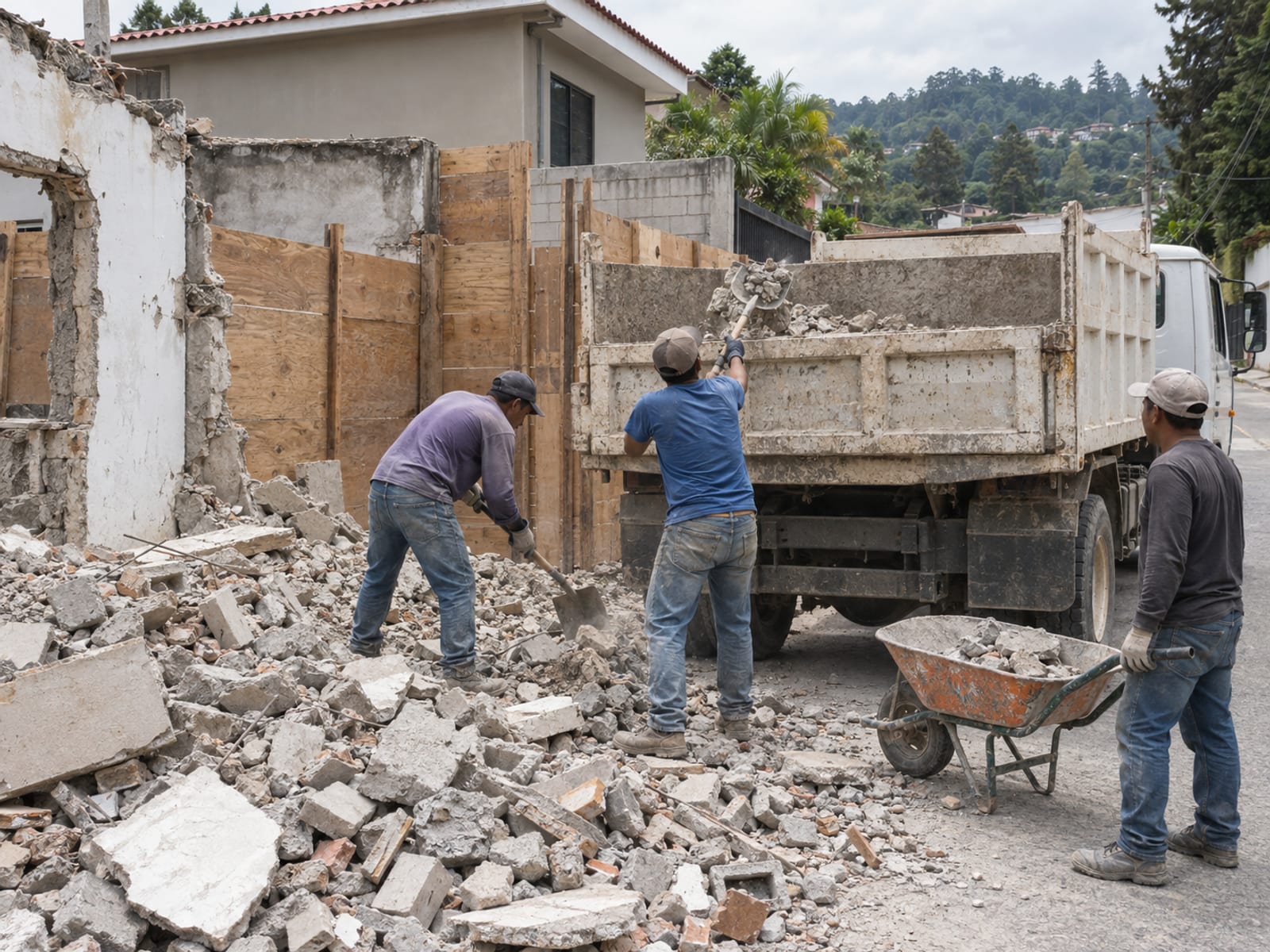
Rubble does not go in the street or on just any lot. For Guatemala City, the Municipality publishes the rules for bringing sandy materials to the Final Disposal Site, the Vertedero Zona 3 (Zone 3 landfill). According to that document, the material must come exclusively from works carried out within the municipality of Guatemala, and the vehicle must display the construction permit, the type of material and the license plates, along with form RMSDF03 updated for each day and each truck. The same document says the Municipality does not charge for receiving those materials at the landfill.
That does not mean removing the rubble is free. The truck, the loading, the trips and the permits still have a cost, and that cost should appear in the quote. In addition, the municipal Traffic Regulation prohibits using roads or pedestrian areas as rubble dumps or places to stack materials.
In other municipalities, the authorized site, the forms and any fees are set by that municipality. At the national level, the Ministry of Environment and Natural Resources publishes the regulation for the comprehensive management of common solid waste and waste, but the instruction about the exact drop-off point comes from the municipality. Ask each contractor to write down the name of the site where they will deliver the rubble and who carries the truck's paperwork.
Which services must be disconnected, and who handles it?
Before machinery enters, the house must be vacant and have no active services. The Guatemala City form asks you to declare that the property is unoccupied, but it does not explain how electricity, water, drainage or gas are disconnected. That is coordinated with each company or agency that provides the service, before the work begins.
The quote should state:
- Who requests each disconnection: you, the contractor, or a relative with authorization.
- Who verifies that it was done: preferably with a certificate or a photograph.
- Who pays any charges: if there are any, and in whose name.
- Which services stay active: for example, a connection that will be used by the new building.
Turning off the light is not the same as a formal disconnection. If you are outside the country, ask a relative or the contractor for photographs of the meter and the shutoff valves, taken before and after.
How do I protect neighboring houses?
The municipal form asks you to declare that protective works will be built for the adjoining properties. In practice, that means protecting the shared walls, the sidewalks and the neighbors' gates while the work lasts. There is no general national duty to notify each neighbor one by one, unless the municipality or the competent authority requires it for your case; even so, letting them know in advance avoids surprises.
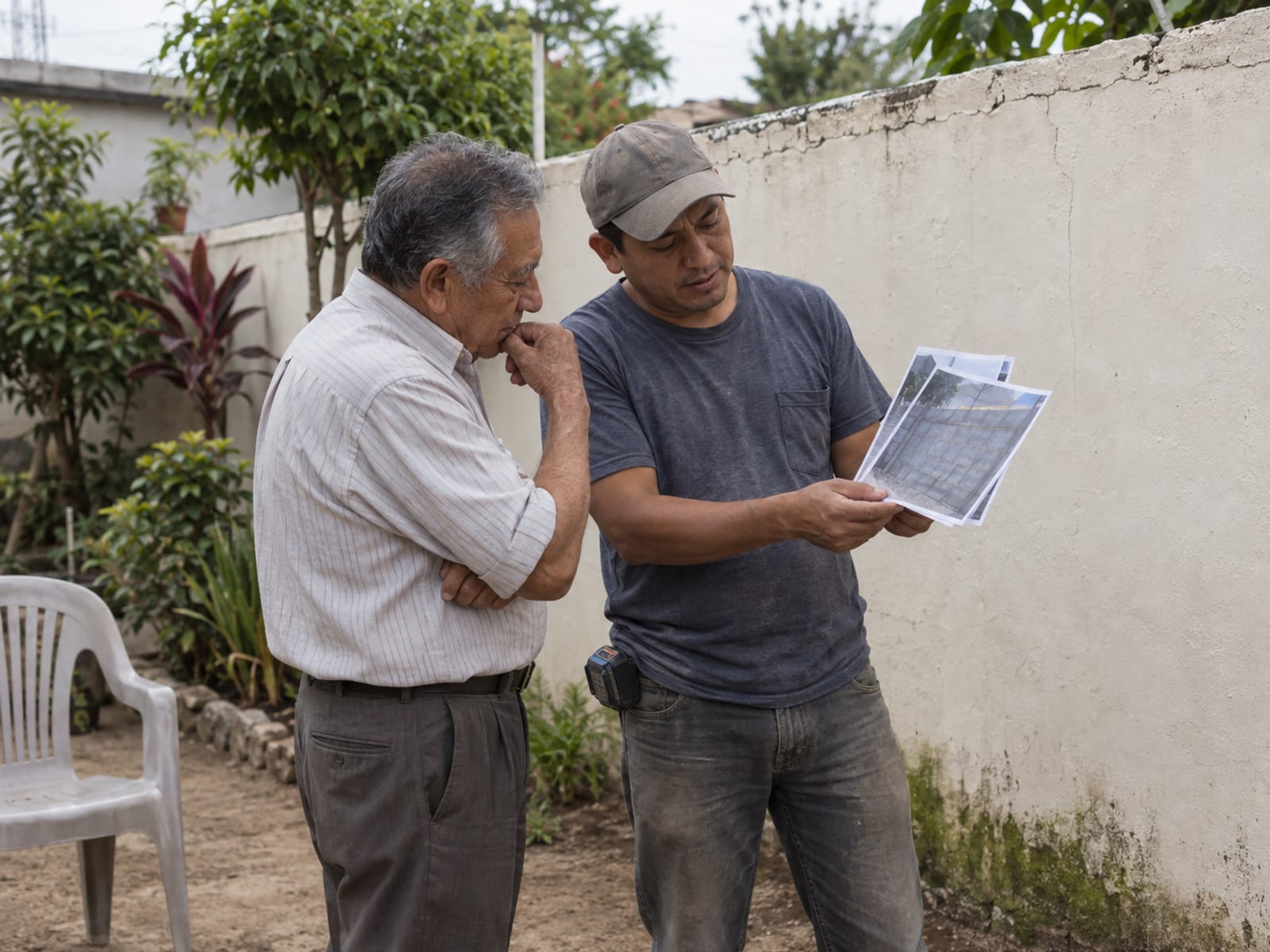
Before you start, take dated photographs of the walls, sidewalks and gates of the nearby neighbors. If a crack or damage appears later, that comparison helps you talk about it clearly. Ask that the quote state who answers for damage to neighbors, to the public road or to utilities.
On safety, the General Regulation on Occupational Health and Safety (Reglamento General de Salud y Seguridad Ocupacional) establishes that, in any demolition or teardown work, the technical direction of the work must inspect the parts of the building to assess their strength and order any necessary shoring. That obligation falls on the contractor and the technical director, as applicable, not on the owner.
What do I do if the house is damaged or may collapse?
A house with damage after an earthquake, or one at risk of falling, should not be decided by an informal inspection. The NSE 6 standard of AGIES, which CONRED publishes, classifies as unsafe a building with a risk of collapse, partial collapse, significant leaning, severe damage to structural elements, or electrical lines at risk. That assessment must be made by a competent person.
Labeling a property as unsafe does not, by itself, authorize demolishing it without coordinating with the municipality, which decides on the works permit. If there is an emergency or a risk condition, CONRED publishes the number 119. For the technical assessment and the permit, consult the municipality that corresponds to the property.
What information should I gather before asking for quotes?
With these details in a single document, two contractors can quote the same work:
- Exact address and municipality, with any cadastral data you have.
- Document proving ownership by the owner or the owner's representative.
- Built area and number of levels, and how they were measured.
- General type of structure and roof.
- Access for people, machinery and trucks.
- Neighboring constructions and the elements to keep, such as trees, gates or walls.
- Active services: electricity, water, drainage and gas.
- Permits, plans or earlier files, if they exist.
- Photographs of the property from every side.
Also decide in advance whether only the buildings will be removed or also the floors and foundation, and whether the lot must be left clean and level.
How do I compare two demolition quotes?
Give both suppliers the same information and ask them to separate demolition, removal, transport, delivery of the rubble, cleanup, permits, disconnections and protection of neighboring properties. When both respond with the same line items, the price difference finally means something.
The Consumer and User Protection Law (Ley de Protección al Consumidor y Usuario) requires service providers to honor the conditions, deadlines, methods and other circumstances offered, published or agreed. It adds that, without a written contract, the basis of the charge is the service actually provided, and that services not provided may not be charged. A written quote does not, on its own, prove that the work is safe or that the supplier holds a professional license; permits and technical responsibility are confirmed with the municipality and with the appropriate professional.
Set payments by stage and say what happens if work not included in the quote turns up, and accept changes only in writing. If you need to find someone to quote, you can review the demolition businesses in the directory and compare their contact details; the directory does not vouch for or rank any of them.
Frequently asked questions about how much it costs to demolish a house in Guatemala
How much does it cost to demolish a house per square meter?
Published figures do not form a national rate for a whole house. CYPE publishes references per cubic meter for partial demolition of buildings, and INTECAP publishes Q43.60 per square meter for one specific false ceiling job. Ask for a quote that states the unit, the scope, removal, rubble delivery and exclusions.
Do I need a permit to demolish a house?
In Guatemala City, the POT includes demolition among the works subject to a permit. In another municipality, confirm the requirements, forms, fees and conditions with the responsible municipal authority before you hire.
Does demolition include removing the rubble?
Not necessarily. The CYPE line items include removal, cleanup and loading, but they exclude the final disposal fee; the INTECAP item includes transport to an authorized dump only for that job. Your quote should say whether it includes loading, transport, the authorized site, the trips and cleanup.
Where can I dump the rubble?
In Guatemala City, certain materials may enter the Vertedero Zona 3 if they meet municipal requirements. For another municipality, confirm the site and the documents with that municipality. Do not use streets, sidewalks or unauthorized places.
What if the house is damaged or may collapse?
Do not decide based on an informal inspection. Request an assessment from a competent professional, consult the municipality, and report any emergency to CONRED at 119.
How do I compare two quotes?
Give both providers the same information and ask them to break down each item. Keep the quote and every change approved in writing.
What to have ready before you hire
Demolishing a house goes smoothly when the information is in order. Confirm the municipality and the permit first, gather the property details, decide what is kept, and ask two providers for a quote with the same scope. Always ask about the unit of the price, where the rubble goes, and who disconnects the services and protects the neighbors. If the property is damaged or at risk of collapse, a competent person should do the assessment, and the municipal authority decides on the permit.
Doing it this way lets you review calmly what each proposal includes and what it leaves out, and it keeps you from paying twice for the same thing or discovering halfway through that nobody planned for the rubble.
If you are looking for masons, master builders or demolition and earthmoving contractors in Guatemala, Albañiles Guate can help you find them and contact them by service and by location; we do not vouch for, rank or certify the businesses in the directory. Write to us from the Albañiles Guate contact page and we will guide you in requesting quotes with the list of details you gathered here. You can also browse the full directory by trade and by location.
Related guides
How to Request a Masonry Quote in Guatemala
A masonry quote in Guatemala should spell out materials, labor, rubble removal, dates, payment stages, and warranty. Review every line before you decide.
How much does a mason charge in Guatemala per day, per m² or per job
How much does a mason charge in Guatemala per day, per square meter or per job, and what a written quote should include: materials, helpers and payments.
Leaks in a concrete slab roof: what to do now
Leaks in a concrete slab roof: why water gets in, which waterproofing suits concrete, when to call an engineer, and what to get in writing before paying.