How to pay for a construction job by progress
You live outside Guatemala, or you manage the work of a relative who lives abroad, and the time has come to make a payment. The builder asks for an advance, or the work has already started and asks for the next transfer, and you have no way to see with your own eyes what was done. Paying for a job by progress comes down to one idea: each payment should match a result that can be seen and checked. To get there, you need to write down which tasks make up each stage, who checks the progress, which receipt you will receive for each transfer, and what happens if something is left incomplete. The word "advance" can also mean different things depending on the agreement, so define it in writing before the first payment. Below you will see how to set up that payment schedule, which documents to request, and what the Guatemalan authorities say about invoices, complaints and money transfers.
Key takeaways
What does "advance" mean, and how much is paid?
In everyday speech, "anticipo" (advance) can be any first payment: money to buy materials, a prepayment on labor or a date reservation. Its real effect depends on what you and the builder agree. That is why the first step is to put it into words: how much is paid, for which work or materials, and when the stage that the money covers is considered complete.
On the amount, the Consumer and User Protection Law (Ley de Protección al Consumidor y Usuario) does not set an advance percentage or a mandatory percentage per stage. Neither does article 2018 of the Civil Code (Código Civil), as amended and published by Congress. That article deals with something else: it says that if the contractor receives advances and does not start the work, or the work does not progress in proportion to the sums received, or it suffers unjustified delays, or uses materials that do not meet the contract specifications, the contractor is liable for the resulting damages and losses. In practice, a figure someone tells you verbally does not replace what you decide in writing. For a specific case, consult a lawyer.
The same consumer law says that whoever provides services must respect the stipulations, deadlines, conditions, methods and guarantees offered or agreed. What is agreed is binding, so it is worth making it clear.

How do I split the job into stages I can check?
Divide the work into results that anyone can see in a photo or during a visit. As a planning method, you can use a sequence like this: preparation and preliminary work; foundation built according to the plans and scope; walls and planned elements raised; roof or cover finished; installations and finishes included; and cleanup, handover and correction of loose ends. This is a guide for organizing your agreement, not a sequence or percentages that the authorities impose.
For each stage, write:
- Included work: exactly what is done.
- Expected materials: what is received or installed.
- Result that closes the stage: how you will know it is finished.
- Who checks: the name of the person who visits the job.
- Evidence: dated photos, a report or an acceptance record.
- What happens to what is incomplete: who corrects it, and within what agreed time.
What do I check before sending the next payment?
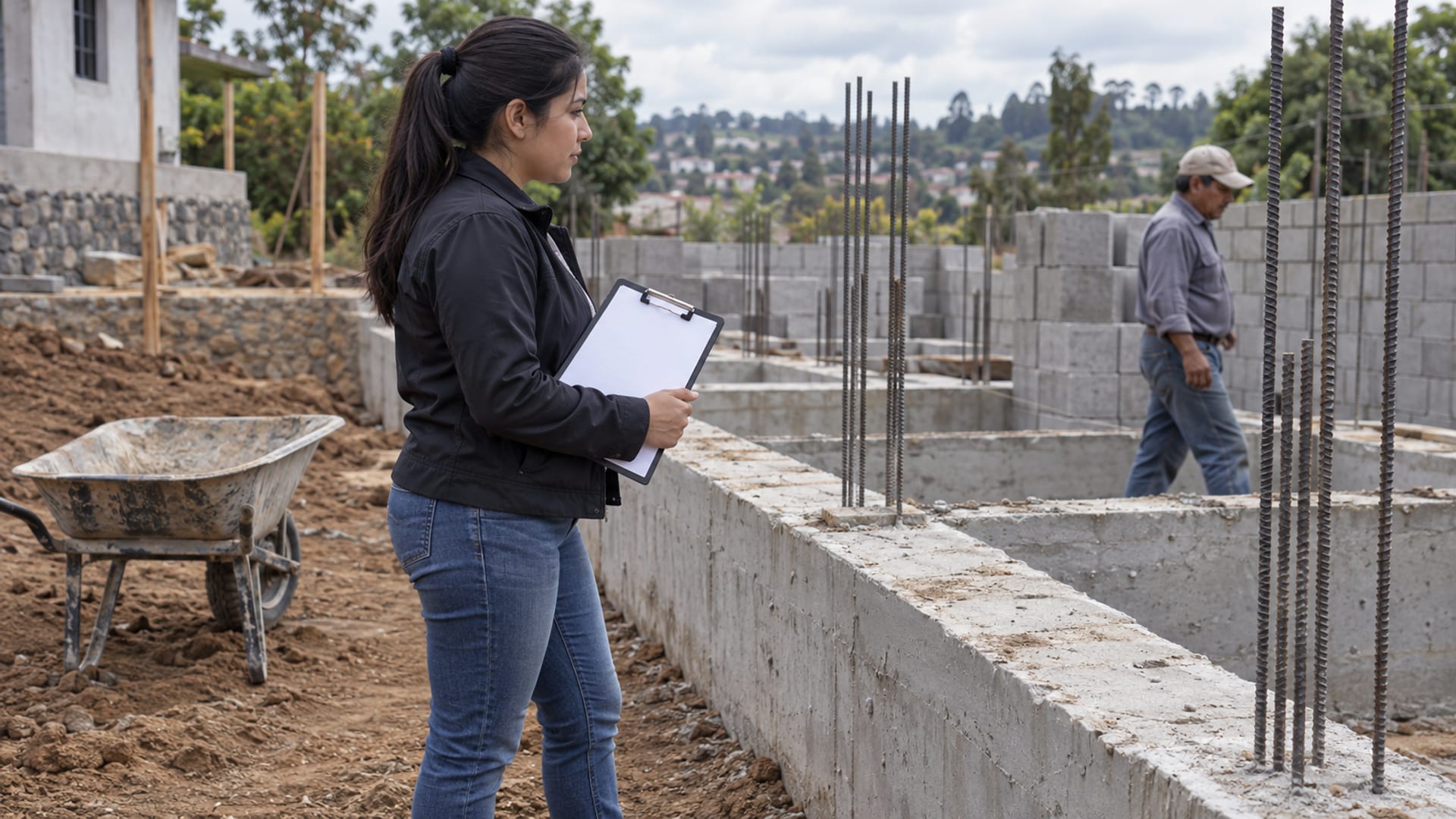
Check what the stage promised, not what looks fine in a single photo. Compare the progress with the written scope, confirm that the materials arrived, and confirm that the result matches what was agreed. Request dated photos and videos, and ask whoever sends them to note which stage they show.
When you are abroad, someone must be your eyes on the job. It can be a relative or a professional whom you ask to visit the site, send dated photos, compare the progress with the scope, confirm the delivery of materials, receive invoices and receipts, and report in writing before you authorize the next payment. If that person is going to sign or handle official procedures on your behalf, consult a notary or the Guatemalan consulate about a special power of attorney (poder especial). A special power of attorney authorizes specific acts, so state exactly what that person may do. The documents, the legalization or the apostille depend on the country where you live, the Guatemalan consulate and the notary.
For work that affects the structure, the builder and the structural designer have defined roles. The standard AGIES NSE 1-2024 describes the builder as the professional under whose responsibility the construction is carried out, and the structural designer as the person responsible for the calculation, the structural design and the structural drawings. Knowing who fills each role keeps a stage payment from being left without a responsible person.
What receipt do I request for each payment?
Ask for two things with every payment: the provider's document and proof that the money was sent. The Superintendency of Tax Administration (SAT) describes the Electronic Invoice Online (Factura Electrónica en Línea, FEL) regime as the system for issuing, transmitting, certifying and keeping invoices, credit notes, debit notes, receipts and other authorized documents. In its frequently asked questions, the SAT states that the issuer may deliver the documents by digital means, such as email, messaging, links or text messages, or on paper if the recipient requests it. The specific obligation of each provider depends on its tax regime, so if you have questions, check with the SAT.

With each payment, ask:
- Will you give me an invoice or the tax document that applies?
- Will the invoice identify the service or the materials charged?
- Can you send it to me by email?
- What is the number, date and amount of the document?
- Which bank receipt or proof of payment confirms the transfer?
A receipt is not automatically a tax invoice, so ask which one you will be given.
DIACO, the Consumer Assistance Directorate (Dirección de Atención y Asistencia al Consumidor), states that to file a complaint it accepts documents such as an invoice, receipt, contract, warranty and account statement that prove the purchase or the provision of the service. That is why it is worth keeping them from the first payment. The law also requires the provider to state in writing the warranty period for the service or repair, under article 33, and that the consumer may claim defects or damages caused by a defective service with the corresponding documentation. If there was no written contract, the basis for the charge is the service provided, and a service that was not provided cannot be charged.
How do I send money to Guatemala to build?
Each transfer channel has its own requirements, costs and timelines, and the choice is yours. What the authorities say is this. The Bank of Guatemala defines family remittances as the funds that Guatemalans who live and work abroad send to their relatives in Guatemala. Its SIPA system allows family remittances to be sent to Central American countries and the Dominican Republic when the sender and the recipient hold deposit accounts at banks in the region; according to its SIPA questions, it does not cover the United States or Europe, and the cost of the transfer is paid by whoever instructs it.
On currency forms, the Bank of Guatemala explains in its guide to completing them that outgoing transactions must record the beneficiary's details, that the user must sign the form, and that family remittances are reported individually per transaction when applicable.
The Superintendency of Banks (SIB) issues warnings that protect both parties. It recommends not lending your name, not opening accounts for third parties, and not receiving transfers or remittances for third parties or taking part in operations whose origin or destination is unknown, according to its recommendations on the use of bank accounts. It also publishes a guide on electronic scams, such as phishing. Before you send money, confirm with your bank or with the regulated provider you choose the identity of the recipient, the limits, the costs, the exchange rate and the method of delivery, and verify the beneficiary's details with the person who will receive the money.

Does the job need a license and a responsible professional?
It depends on the work and the municipality, and you should know this before the first payment. In Guatemala City, article 82 of the Territorial Planning Plan states that the owner must hold the corresponding works license before carrying out the works covered by the regulation, and the Ventanilla Única (the city's single-window permit counter) explains that the file is submitted with forms and requirements according to the type of request. The conditions for issuing the license are in article 85. Other municipalities have their own rules and competent offices.
For someone paying from abroad, it is useful to write into the agreement who handles the license, who designs, who builds and who supervises. It is also worth defining who can represent you before the municipality or the builder.
If you need to find who to contact in your area, you can review the builders in the directory by service and by place.
What do I do if there is unfinished work, defects or changes?
Decide this before it happens, not when it does. The agreement can state that, before the next payment, the previous stage will be reviewed, the loose ends will be noted, and it will be defined who corrects each defect and within what deadline. Record whether each stage was accepted, accepted with pending items or pending review.
If a change comes up mid-project, ask for it in writing, stating what changes, how much it costs and how it affects the timeline. If defects appear after you have paid, review the written warranty, gather photos, invoices, receipts, the contract and messages, and contact the provider as agreed. If it is not resolved, DIACO receives consumer complaints through its official channels, including its complaints book. For a specific dispute or a breach, consult a lawyer or a notary.
Frequently asked questions about how to pay for a construction job by progress
How much advance is paid for a construction job?
The law does not set a general advance percentage for private construction. The agreement must describe the advance, the stages, the corresponding work and the receipts. DIACO requires the agreed conditions to be respected, and the Civil Code mentions advances in relation to the progress of the work and unjustified delays.
How do I pay for a job in stages?
Define each stage by an observable result and agree on what will be checked before the next payment. Describe the included work, the materials, the progress documents, the loose ends and the acceptance.
What receipt should I ask for with each payment?
Ask for the invoice or the tax document that applies, and keep the bank confirmation, the receipt, the document number and the date. The SAT allows electronic documents to be delivered by digital means or on paper if the recipient requests it.
How do I send money to Guatemala to build a house?
Check with the bank or regulated provider you will use about the identity of the beneficiary, requirements, costs, exchange rate and method of delivery. The Bank of Guatemala publishes information about remittances and transfers, and the SIB warns about the use of bank accounts and electronic scams.
Can a relative check the job for me?
Yes. You can ask them to visit the site, send dated photos, confirm deliveries and receive documents. If they must sign or handle official procedures on your behalf, ask a notary or a consulate about a special power of attorney.
What do I do if defects appear after I have paid?
Review the written warranty, gather your documents and contact the provider. DIACO indicates that the provider must state the warranty period in writing and that the consumer may claim defects with the corresponding documentation.
Your payment schedule, in summary
Write down the scope and the exclusions, divide the work into visible stages, name who will check the work in Guatemala, and decide what evidence is needed before each transfer. Agree in writing on the advance, the price and the conditions; request an invoice or receipt and the confirmation of the transfer; and record the loose ends and the warranty. Confirm with the municipality whether the work requires a license and who will be the responsible professional.
With that order, each payment stops being an act of faith and becomes a decision with support. If something goes wrong, you will have the papers that consumer authorities ask for when handling a complaint.
Albañiles Guate helps people in Guatemala find and contact masons, builders and related construction trades by service and by place. If you are organizing a job from abroad and want to start requesting proposals, write to us from our contact page and tell us what you need.
Related guides
How to Request a Masonry Quote in Guatemala
A masonry quote in Guatemala should spell out materials, labor, rubble removal, dates, payment stages, and warranty. Review every line before you decide.
What a Written Scope of Work for a Masonry Job Should Include
Before you hire, write down what the job includes, who buys and removes materials, the start and end dates, payments, final cleanup, and the warranty period.
When to consult a structural engineer before building work
Before you remodel, check whether the change touches walls, slabs or foundations. Learn when to consult a structural engineer and what to bring to the visit.