Price of a perimeter wall per meter in Guatemala
You own a lot and want to enclose it, so you ask for prices and get answers that do not match. One says "Q1,500 per meter," another says "Q270 per square meter," and a third quotes only the materials. The price of a perimeter wall per meter in Guatemala depends on the unit a figure is published in and on what that figure includes. A linear meter measures only the length of the wall. A square meter measures length times height. If one quote uses one unit and another uses the other, you cannot compare them without knowing what height was quoted. It is even harder when one includes the foundation and the other does not. This happens to someone fencing an empty lot and to someone living abroad who organizes the work from a distance. Below you will find the published figures, how to read them, and what to ask for in writing so that two offers describe the same wall.
Key takeaways
How much does it cost to fence a lot with block?
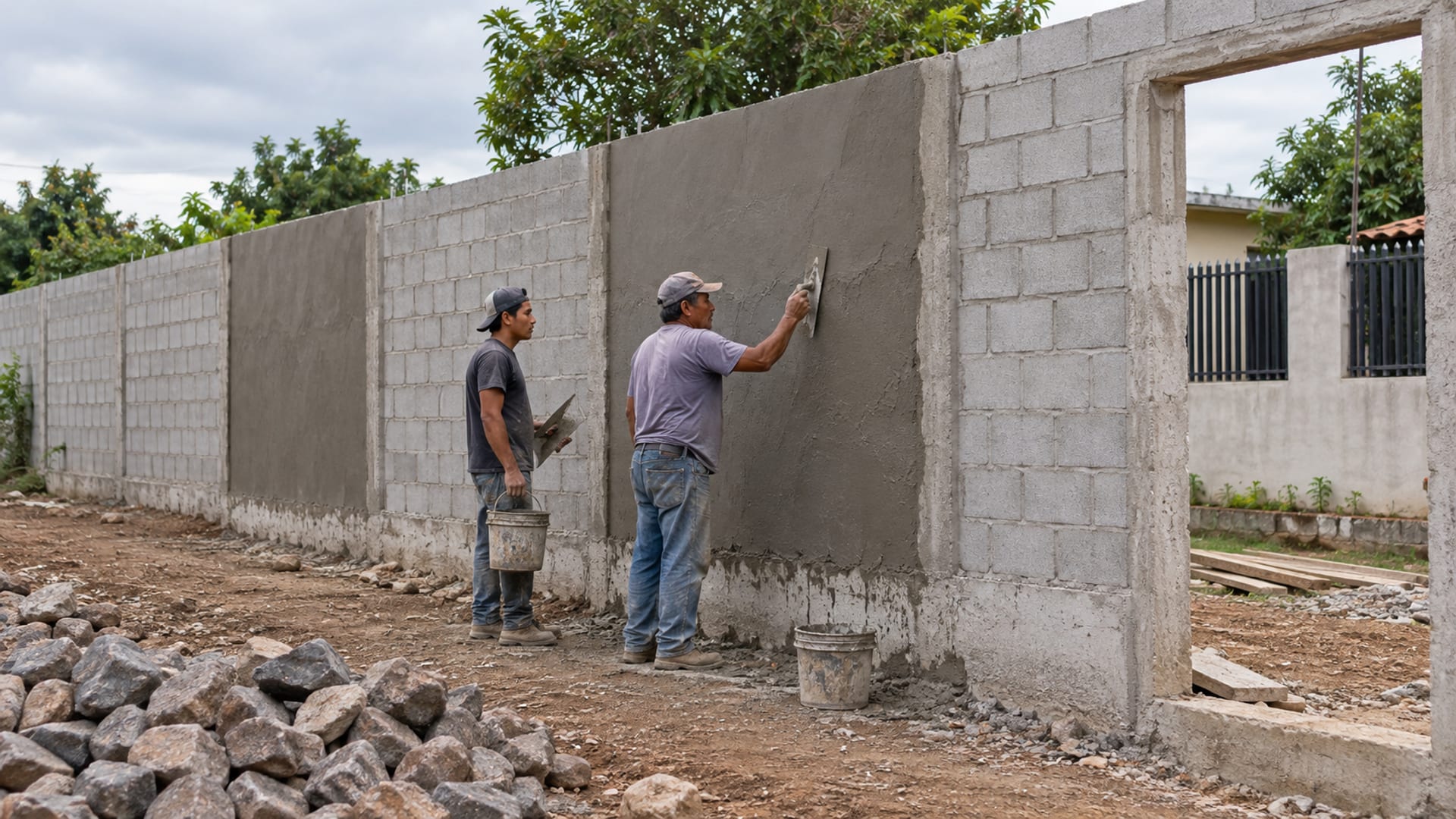
Published figures for block walls are not in the same unit, so read them one at a time. The Secretariat of Planning and Programming of the Presidency (SEGEPLAN) published in its cost guide, dated 2013, a reference of Q1,500 per linear meter for a "clean" block perimeter wall ("muro perimetral de block (limpio)"). That guide is from 2013, so it works as a historical reference, not as a current quote. The excerpt also does not state the height, foundation, columns, transport or finish included.
Another figure comes from a thesis from the University of San Carlos of Guatemala, an academic project from 2018 in Guatemala City: Q384.03 per square meter of wall built from 14 cm pumice block, including materials, labor, tools and overhead. That thesis calculates the foundation and columns separately, so the price for laying the wall does not represent the full cost of the enclosure.
To be clear: a 2013 figure per linear meter and a 2018 figure per square meter do not form a range. They are two published data points with different units, dates and scopes. They do help you understand what to ask.
What is the price per linear meter of a precast wall?
Precast systems are usually published per square meter, not per linear meter. To convert one to the other, multiply by the height of the wall. For example, a wall 2.5 m high has 2.5 m² for every meter of length, so a price of Q100 per m² equals Q250 per linear meter. This example only shows the conversion; it is not a quote.
These are the published figures for precast:
- Procreto: publishes on its website, in 2026, an approximate price of Q120 per m² for its precast concrete fence and post system, with heights of 2, 2.5, 3 and 3.5 m. The page says the price varies with height and length, and does not say whether it includes installation, foundation, transport or finish.
- PrecoGuate: publishes on its website, in 2026, Q135 per m² for materials only and Q270 per m² as an estimate for materials and installation. Freight is charged separately, according to the page.
- SEGEPLAN: a public budget shows Q148.13 per m² for supply and installation of a perimeter precast wall, in a line item covering 340 m². This is a budgeted price for one specific project, not a general rate.
- University of San Carlos: the same 2018 thesis calculates Q265.40 per m² for precast concrete panels, with posts, excavation and casting, for an academic project of 303.46 m².
Can these prices be compared in one table?
They can be sorted, provided each row states its unit and scope. What you cannot do is average them or state which system costs less, because the rows measure different things. The table below gathers what has been published, with its source and date.
For precast, the published figures run from Q120 to Q270 per m², but that band mixes materials-only prices, commercial estimates, a public budget and an academic calculation. It is a set of reference points, not the price you will pay. The figure that matters is the one for your lot, with its height and access, written in a dated quote.
What separates a complete quote from a partial one?
A partial quote can be correct and still be incomplete for what you need. A block wall, for example, is made of several line items: foundation, columns, bond beams (soleras), block laying, plaster (repello), fine finish (cernido) or paint. In precast, posts, panels and their installation are added. Both systems also involve a gate, a door, freight, unloading, excavation, backfill and removal of rubble.
Ask about each of these points and request that the answer say "included," "excluded" or "to be confirmed":
- Length and height: in meters, with the exact height that was quoted.
- System and product: block or panels and posts, with the type and size.
- Foundation: whether it is included.
- Columns, posts, bond beams and reinforcement: included or excluded.
- Finish: exposed block, plaster, fine finish, paint or other.
- Gate, door and hardware: quoted separately or within the total.
- Transport and unloading: who does them and how the lot is reached.
- Excavation, backfill, removal of rubble and final cleanup.
- Schedule and payment stages: in writing.
- Taxes, invoice and validity of the quote.
What materials does a block wall use, and what do they cost?
If you buy the materials yourself, or want to understand where the cost of the laying comes from, supply prices help. They are reference points, not quotes for your job. The National Statistics Institute (INE) published these prices of block delivered to the site, per thousand ("por millar"), in March 2024:
There are also more recent commercial figures. Rey Block publishes 15 x 20 x 40 cm block, with an advertised strength of 35 Kgf/cm², from Q623 per pack of 1,000 units; the page does not print the date of its price list, so confirm the current price with the supplier. In the commercial table from Living in Guatemala, dated August 2026, cement in 42.5 kg bags appears between Q77 and Q81 per bag, and 3/8 inch rebar, 6 m long, grade 40, at about Q31 per bar. The INE and commercial figures come from different dates and suppliers, so do not add them together to calculate a budget.
Do I need a license to build a wall?
The answer comes from the municipality where the lot is located, and each municipality has its own procedure. In the capital, the Ventanilla Única (the city's single-window permit counter) of the Municipality of Guatemala explains that you obtain the forms and requirements according to the type of request, complete the file and submit it for review. Files that meet the requirements are entered into the system and receive a receipt password. The Territorial Planning Plan of the capital sets the setbacks from neighboring lots and establishes that areas assigned to public service may not be enclosed with solid walls. In a zone with a special regulation, such as Santa Clara, the Municipality of Guatemala requires certain decorative finishes for parking areas that face the public road, and prohibits some precast walls and exposed block there. That is a sector rule, not a national one.
In Mixco, the Manual of Organization and Functions states that the construction processes listed in article 3 of its Construction and Urban Development Regulation, when carried out on private property, must be covered by a municipal license or authorization. It assigns to the municipality the review of requirements and the granting of licenses.
If the lot is in another municipality, check with that office. Each municipality sets its own heights, setbacks and alignments. And if you are unsure where your land ends, that is a question of property boundaries, so raise it with a lawyer, with your property documents at hand.
What if the ground is sloped?
A wall that holds back soil is no longer a simple enclosure. The National Coordinating Office for Disaster Reduction (CONRED) defines a retaining wall as a rigid structure meant to hold back soil or other loose materials that cannot keep their natural slope. In its rain recommendations, CONRED notes that slopes and poorly drained land can face landslide risk. The standard NRD-1 sets minimum technical criteria for designing new works, remodeling and repairs, and the standard AGIES NSE 5.3-2024 governs retention works.
In practice: if your lot has a slope, fill, or a height difference with a neighbor, tell each supplier before you receive a price, and consult a qualified professional. That professional decides whether the wall also retains soil and how it must be designed. The mason who quotes the job does not replace that design.
How do I request two quotes that can actually be compared?
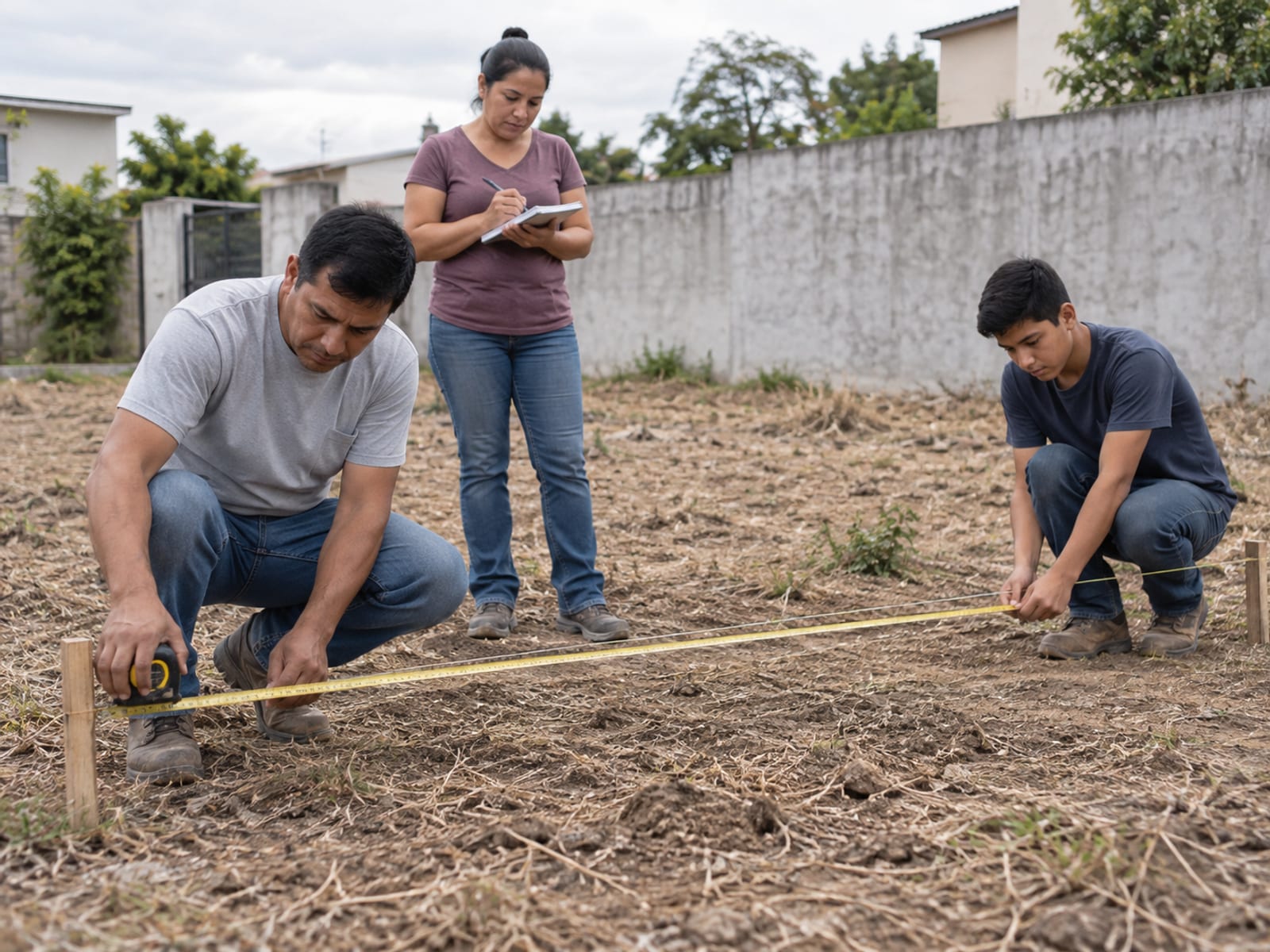
The most direct way is to send each supplier the same package: total length, height, system, finish, gate, access and photos of the lot. Request one quote for block and another for precast, with exactly the same measurements. Then move the answers into a table with the same columns, and write "not stated" wherever a detail is missing.
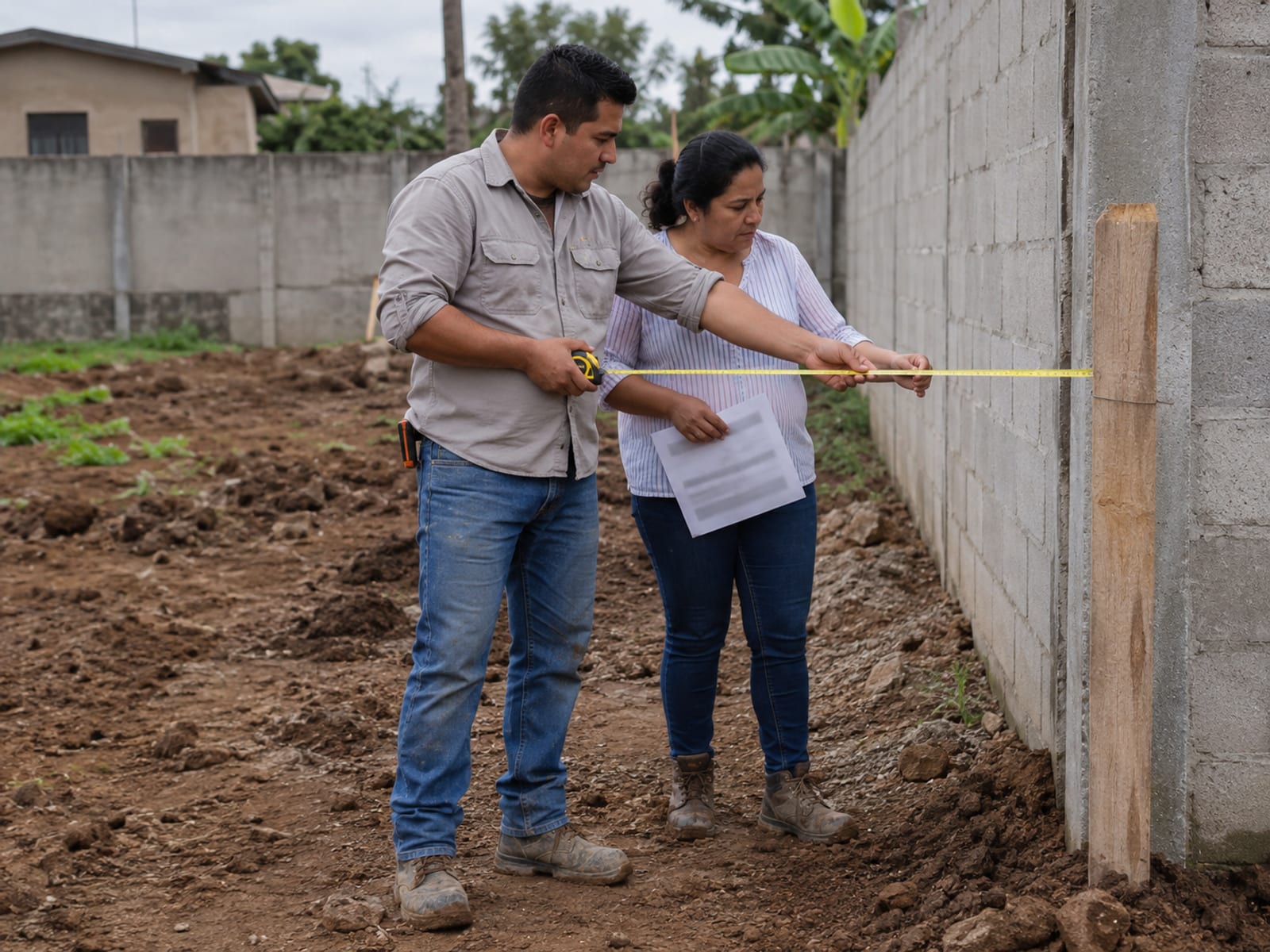
If you buy materials yourself, state who transports them and who unloads them. If you pay in stages, request the payment schedule in writing. For consumer questions, the Consumer Assistance Directorate (Dirección de Atención y Asistencia al Consumidor) handles complaints under its procedures, so keep quotes, contracts, invoices and payment receipts.
If you want to see who offers these trades in your area, you can review the masons and builders in the directory by service and by place.
Frequently asked questions about the price of a perimeter wall per meter in Guatemala
How much does a perimeter wall cost per meter?
It depends on the unit and the scope. SEGEPLAN published Q1,500 per linear meter for a clean block wall in a 2013 guide. Other calculations publish Q384.03 per m² for block and between Q120 and Q270 per m² for precast systems with different scopes. Always ask for the unit, the height, the foundation, the installation, the transport and the finish.
Which costs less, block or precast?
The published figures do not allow a single answer. The USAC thesis calculated Q384.03 per m² for block and Q265.40 per m² for precast panels, in an academic project from 2018. PrecoGuate publishes Q135 per m² for precast materials only and Q270 per m² with installation. The scopes are not the same.
Does the price of precast include installation?
Not always. Procreto publishes Q120 per m² as an approximate price, and that page does not state whether installation is included. PrecoGuate separates the materials-only price from the offer with installation, and charges freight separately.
What should a block quote include?
Length, height, type of block, mortar, foundation, columns, bond beams, finishes, transport, gate, cleanup and removal of rubble, all in writing. The USAC thesis calculates the wall, the continuous footing and the columns separately, which shows that the price of the laying is not the full cost.
Do I need a license to build a wall?
It depends on the municipality. The Municipality of Guatemala processes licenses through its Ventanilla Única, and Mixco requires a license or authorization for the construction processes in its regulation. Check with the municipality of the lot before you start.
What if the ground is sloped?
A slope can call for a retaining wall, which is a different work from an enclosure. Ask a qualified professional for an evaluation and check with the municipality.
Before requesting the two quotes
Measure the perimeter, set the height, and use the same specification sheet with every supplier. With those three pieces of information, a price per linear meter and a price per square meter stop being a mystery: you can convert one into the other and see what each includes. Ask each offer to separate materials, installation, foundation, columns or posts, finish, freight, gate and cleanup, and flag any slope on the lot from the start.
With that information, choosing between block and precast becomes a comparison of scopes, not a bet on the total. And you will have in writing what was agreed, what it costs and when it will be delivered.
Albañiles Guate helps people in Guatemala find and contact masons, builders and related construction trades by service and by place. If you want to start requesting proposals to fence your lot, write to us from our contact page and tell us what you need.
Related guides
How to Request a Masonry Quote in Guatemala
A masonry quote in Guatemala should spell out materials, labor, rubble removal, dates, payment stages, and warranty. Review every line before you decide.
How much does a mason charge in Guatemala per day, per m² or per job
How much does a mason charge in Guatemala per day, per square meter or per job, and what a written quote should include: materials, helpers and payments.
Leaks in a concrete slab roof: what to do now
Leaks in a concrete slab roof: why water gets in, which waterproofing suits concrete, when to call an engineer, and what to get in writing before paying.